|
The HP9825W
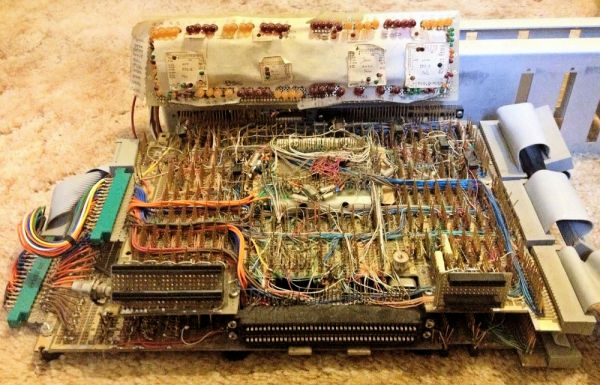
In 1977, the year after the HP9825A was announced, Greg Lawson and Dyke Shaffer used HP 3000 minicomputer-format prototyping boards to create a Wire-Wrap test fixture called the ET10162, which was used as a bus monitor for the HP 9835. Shaffer also built the ET10161 16-bit Hybrid Microprocessor tester using the same assembly technology. The ET10161 was used for production testing of HP’s Hybrid Microprocessor until a printed-circuit-board version was completed. The printed-circuit version of the ET10161 was a mother board with three plug-in boards. Shaffer thought this test fixture might be a great way to support future prototypes, so he submitted drawings and schematics for a kludge card and motherboard, with slots for three prototype boards and the power-supply board from a 9825.
This same test fixture was used to develop and prove out the bit-slice version of the BPC (Binary Processor Chip) for the 9845B and 9845C Fast LPU (Language Processing Unit) option 200. The Fast LPU multi-board set for the 9845B and C was based on chips from AMD’s bipolar Am2900 bit-slice processor family including the bit-slice ALU and bit-slice address sequencer. The board set replaced the 9845’s processor board, which was based on the 16-bit HP Hybrid Microprocessor. The Fast LPU board set improved Basic language performance by 5x to 7x by implementing time-critical portions of the 9845’s Basic language interpreter in on-board microcode.
After Shaffer completed the printed-circuit version of the ET10161, he went looking for something else to do while also being involved in the development of the Redwood Interface Bus. The Redwood project was designed to be a computer-controlled modular instrument, like the Tektronix TM500 modular test equipment system but with the addition of in-box computer programmability.
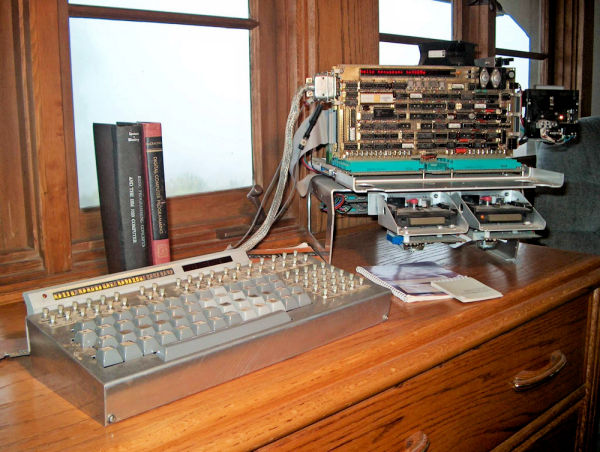
Shaffer constructed a Wire-Wrap processor based on the 9825A architecture including a ROM and mated it to an HP 9835 memory board. He then constructed a Wire-Wrap version of the 9825’s KDP (Keyboard/Display/Printer chip) and built a keyboard with a display, adding two DC100 tape drives. Shaffer used this piece of equipment as a personal 9825 to complete the kasmbin binary because the original software development system, based on an HP 3000 minicomputer, tape punch, and paper tape reader, were no longer operational. The resulting HP 9825w proved to be a worthy workhorse that Shaffer used for many years, long after the 9825A was discontinued.
|